In December 1828, Mary Anning prised a strange winged skeleton out of the cliffs at Lyme Regis, on the south coast of England. It was one of the first pterosaurs anyone had ever found, and it was nothing like the delicate Pterodactylus of the textbooks.1 Dimorphodon was a small animal, only about a metre from nose to tail with a wingspan under a metre and a half, but it carried a tall, deep head, almost like a puffin's, that looks far too heavy for the body behind it.
A head built like a cage
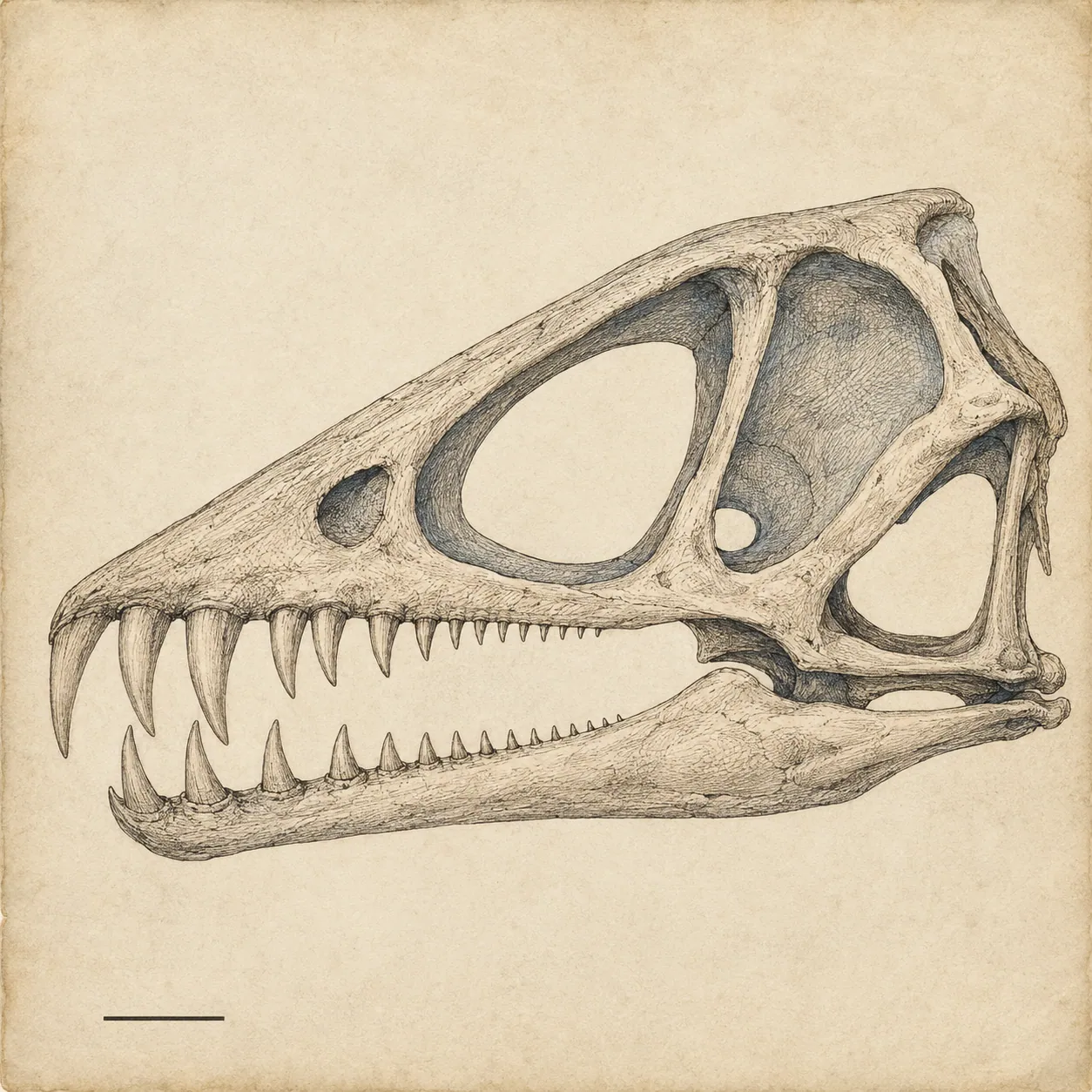
That head is the first clue to how pterosaurs cheated gravity. The skull is large, but it is mostly window: great openings separated by thin bony struts, so the whole structure stayed light. Richard Owen gave the genus its name in 1859, and the name itself records its oddest feature. Dimorphodon means "two-form tooth." At the front of the jaws sit a few long fang-like teeth; behind them runs a row of much smaller ones, dozens of tiny points in the lower jaw alone.1 Having two clearly different kinds of teeth in one mouth is rare, and it gave the animal both grip and a holding bite.
What did it eat?
People have argued about its diet since the beginning. William Buckland, who first described the bones, guessed insects; later writers leaned toward fish. The current reading, set out by Mark Witton, is a small generalist carnivore that took insects and small vertebrates with a quick "snap and hold" bite, and studies of microscopic wear on the teeth point the same way, toward a hunter of other animals rather than a sifter of bugs.1
Better on its feet than in the air
For all its wings, Dimorphodon was not built for long flight. Its wings were short and broad, with little gliding potential, so it probably managed only brief, busy bursts of flapping, the way a pheasant breaks from cover. On the ground it walked on all fours, and its long curved claws mark it as a capable climber. An old idea that it hopped about upright on two legs, floated in the nineteenth century and revived in the twentieth, does not square with the four-footed trackways pterosaurs left behind.1
The name records its oddest feature: Dimorphodon means "two-form tooth."