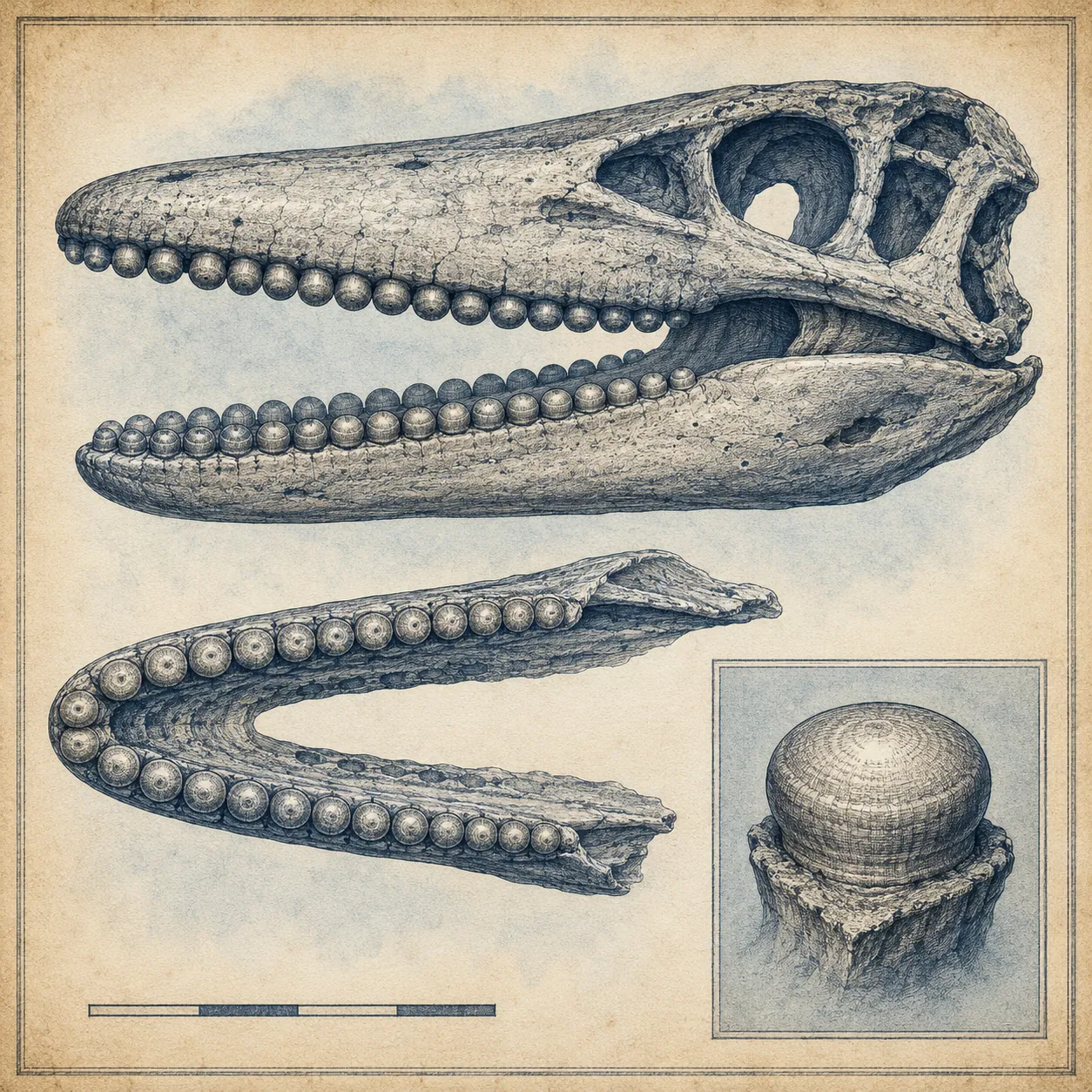
Most mosasaurs are armed for cutting and gripping, with teeth like curved daggers. Globidens went the other way. Its name means "globe teeth," and that is exactly what it had: rows of low, round, almost spherical teeth set in a heavy jaw.1 It was a six-metre lizard that had specialised, completely, in food that fought back with a shell.
A mill, not a blade
Those teeth are unmistakable. They are blunt and rounded, with thick enamel, and they work like a mill: clamp a hard object between upper and lower rows and squeeze until it gives. The favoured prey were the armoured animals of the Cretaceous sea floor, the thick-shelled clams, ammonites and nautili, and probably turtles too.1 This is not a guess. A Globidens from South Dakota was found with the crushed shells of inoceramid clams still in its stomach, the smoking gun for a shell-crusher's diet.1
Its name means "globe teeth," and that is exactly what it had.
One specialist among many
Charles Gilmore named the genus in 1912 from a partial Alabama specimen, and more have since turned up across the warm Cretaceous world, from the Americas to Morocco, Syria and Angola.1 Globidens matters less for its size than for what it shows: that the mosasaurs did not just get bigger over time, they spread out, carving the ocean into jobs. While the giants ran down fish and each other, this one quietly took over the seabed's hard cases, a niche almost no other marine reptile of its day could touch.