Every group needs a first member, the one that gives the rest its name. For the mosasaurs that animal is Mosasaurus itself, and it was a monster: a marine lizard that reached eleven or twelve metres, weighed something like ten tonnes, and sat at the very top of the food web in the last seas of the Cretaceous.1 It ruled until the afternoon the asteroid fell, and then it was gone with everything else.
The beast of Maastricht
The story starts underground. In the 1770s, quarrymen cutting chalk beneath the Dutch city of Maastricht hauled out an enormous fanged skull. It passed through several hands, was fought over, and was eventually carried off to Paris as spoils of war in 1794. There the anatomist Georges Cuvier studied it and reached a startling conclusion: this was not a whale or a crocodile but a giant marine lizard, a relative of the monitor lizards, and a kind of creature no longer found anywhere on Earth.1 At a time when many doubted that extinction was even possible, the "great animal of Maastricht" became a key piece of evidence that it was.
It did not get its name until later. William Conybeare coined Mosasaurus in 1822, from the Latin for the river Meuse that runs through Maastricht and the Greek for lizard; Gideon Mantell added the species name hoffmannii in 1829, after a local doctor who had helped recover the skull.1
A lizard, not a dinosaur
That early reading has held. Mosasaurs were squamates, the great group that today contains the lizards and snakes, and Mosasaurus sat close to the monitors. Exactly which living animals are its nearest kin, monitors or snakes, is still argued.1 What is not in doubt is that it was a lizard that had gone all the way back to the sea: limbs reshaped into paddles, a long body driven by a downturned, finned tail.
Jaws built to swallow anything
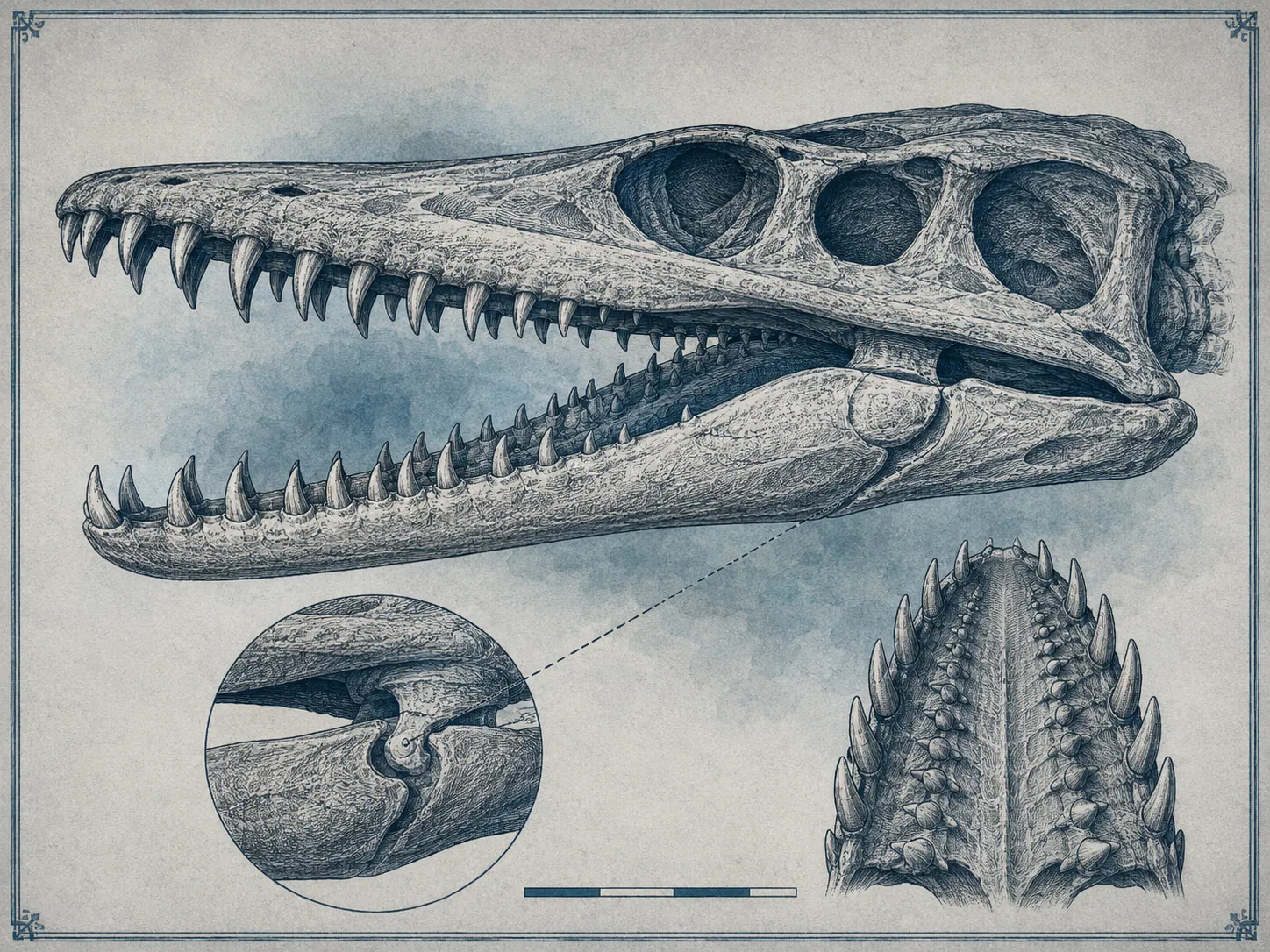
Its mouth is where the size really tells. The teeth are prismatic, with sharp cutting edges meant to slice rather than just grip. The lower jaw carried an extra joint that let it flex, and the roof of the mouth bore a second row of teeth on the pterygoid bones, the same trick snakes use to walk prey down the throat.1 The result was a generalist that ate more or less whatever it met: bony fish and sharks, squid and ammonites, seabirds, sea turtles, and other mosasaurs. Two specimens have been found with their last meals still inside them, and microscopic wear on the teeth backs up the same picture, a predator that was not fussy.1
At a time when many doubted extinction was even possible, the beast of Maastricht became evidence that it was.
There is even a long-running argument about how big the largest individuals grew, with some estimates pushing past eighteen metres. Whatever the true maximum, Mosasaurus was among the last and largest of its kind, still patrolling the seaways when the curtain came down sixty-six million years ago.