The same Kansas chalk that gives us Pteranodon also gives us its stranger neighbour. Nyctosaurus was a small, toothless pterosaur of the Late Cretaceous open ocean, a little over two metres across the wings.1 Two things set it apart from almost every other flying reptile: the thing on its head, and the things it had lost from its hands.
An antler for a crown
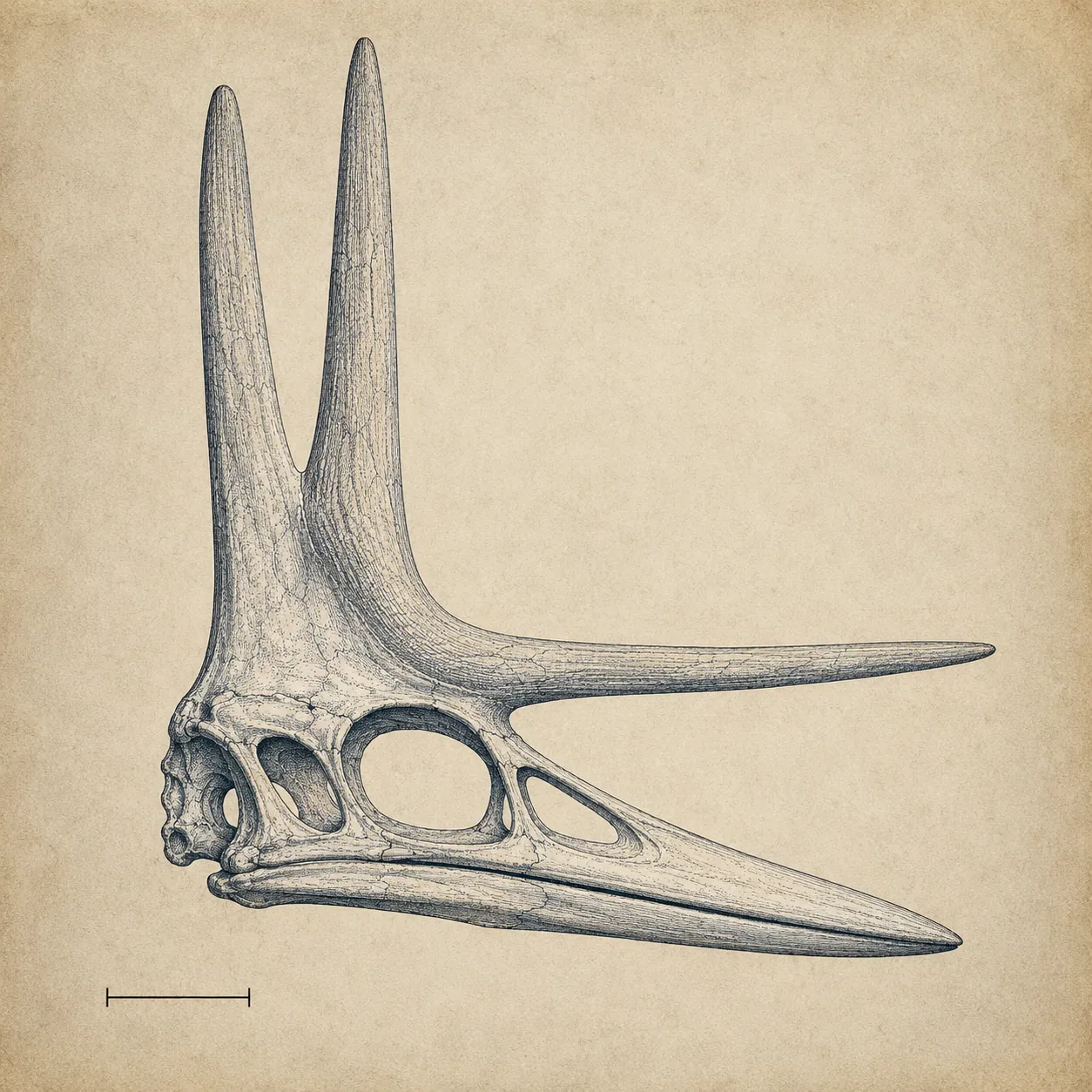
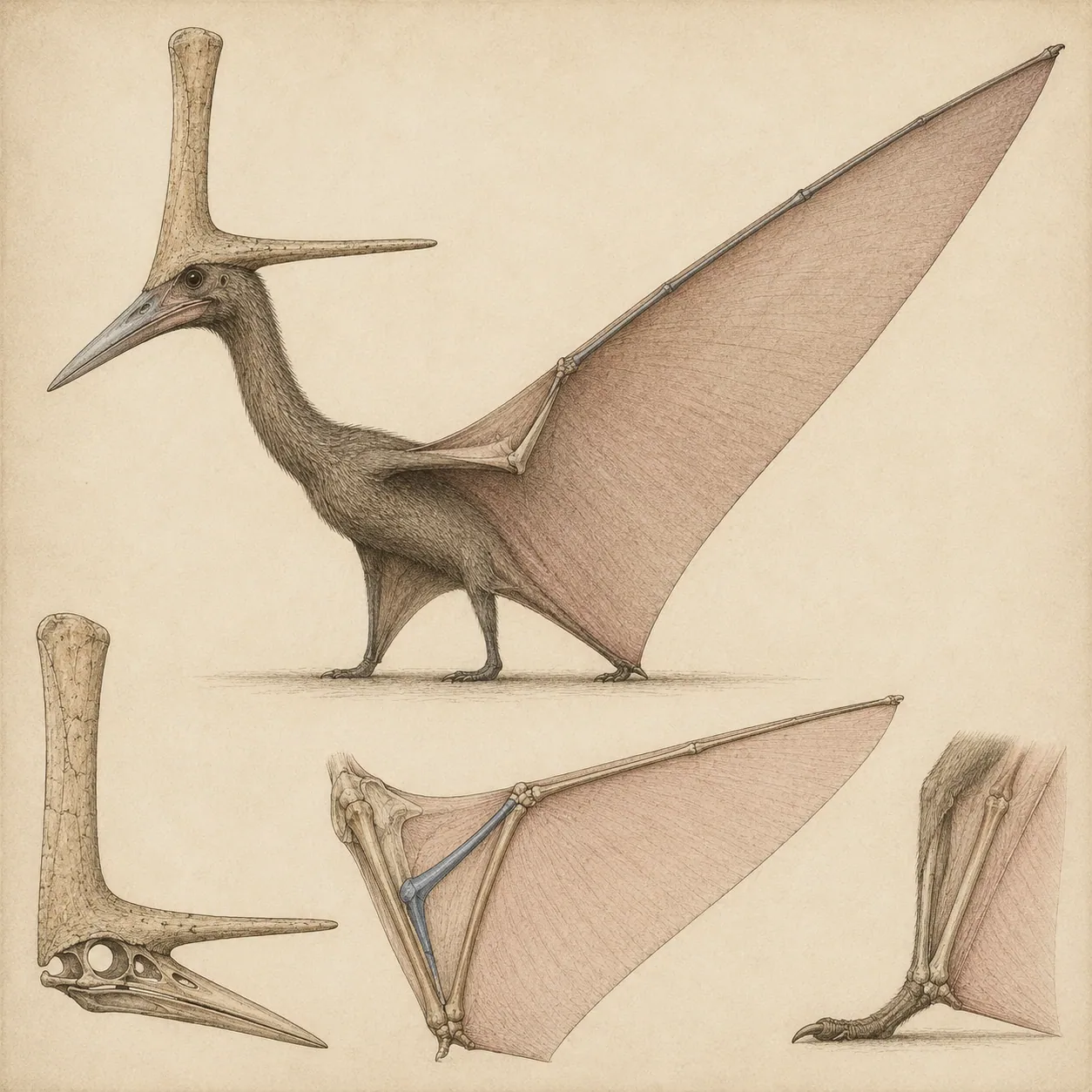
Adult Nyctosaurus carried a crest at least fifty-five centimetres tall, far longer than the skull beneath it: two long grooved spars rising from the back of the head, one pointing up and one swept back, for all the world like an antler.1 For years the obvious question was whether a sail of skin stretched between the two prongs, and some reconstructions drew one in. Chris Bennett, examining the bone, found no sign of the attachment points a membrane would leave, so the crest was most likely bare bone; later aerodynamic modelling suggested it would not have spoiled the animal's flight either way. The crest was almost certainly there to be seen, a display.1
The flyer that gave up its fingers
Most pterosaurs keep three small clawed fingers at the bend of the wing. They fold the wing away and walk on those fingers, knuckling along on all fours. Nyctosaurus threw them away. Every digit but the long wing-finger is gone, which would have made it clumsy and slow on the ground.1 The reading is that it barely needed to land: an animal that spent almost all of its time on the wing, riding the sea winds like an albatross or a frigatebird and coming down only when it had to.
Marsh's night lizard
Othniel Charles Marsh named the animal in 1876, at first taking it for a species of Pteranodon before recognising it as something distinct. The name means, roughly, "naked lizard." With its slender toothless jaws it would have plucked fish from the surface of the Western Interior Seaway, a specialist of the open air over open water.1
It threw away every digit but the long wing-finger. It barely needed to land.