Platecarpus was a mid-sized mosasaur, a little under six metres, short-snouted and quick, and for a long time it was best known simply for being common in the Kansas chalk.1 Then one specimen turned it into one of the most important mosasaurs ever found.
A skeleton with its skin on
The specimen, catalogued as LACM 128319 in Los Angeles, is not just bone. It preserves the body outline as a film around the skeleton, patches of scaly skin, and darker stains where the soft anatomy had been: what look like the remains of bronchial tubes, parts of the digestive tract, and even a possible trace of the eye's retina, with chemical signatures of iron and the breakdown products of haemoglobin.2 Fossils this complete are vanishingly rare for any large marine reptile.
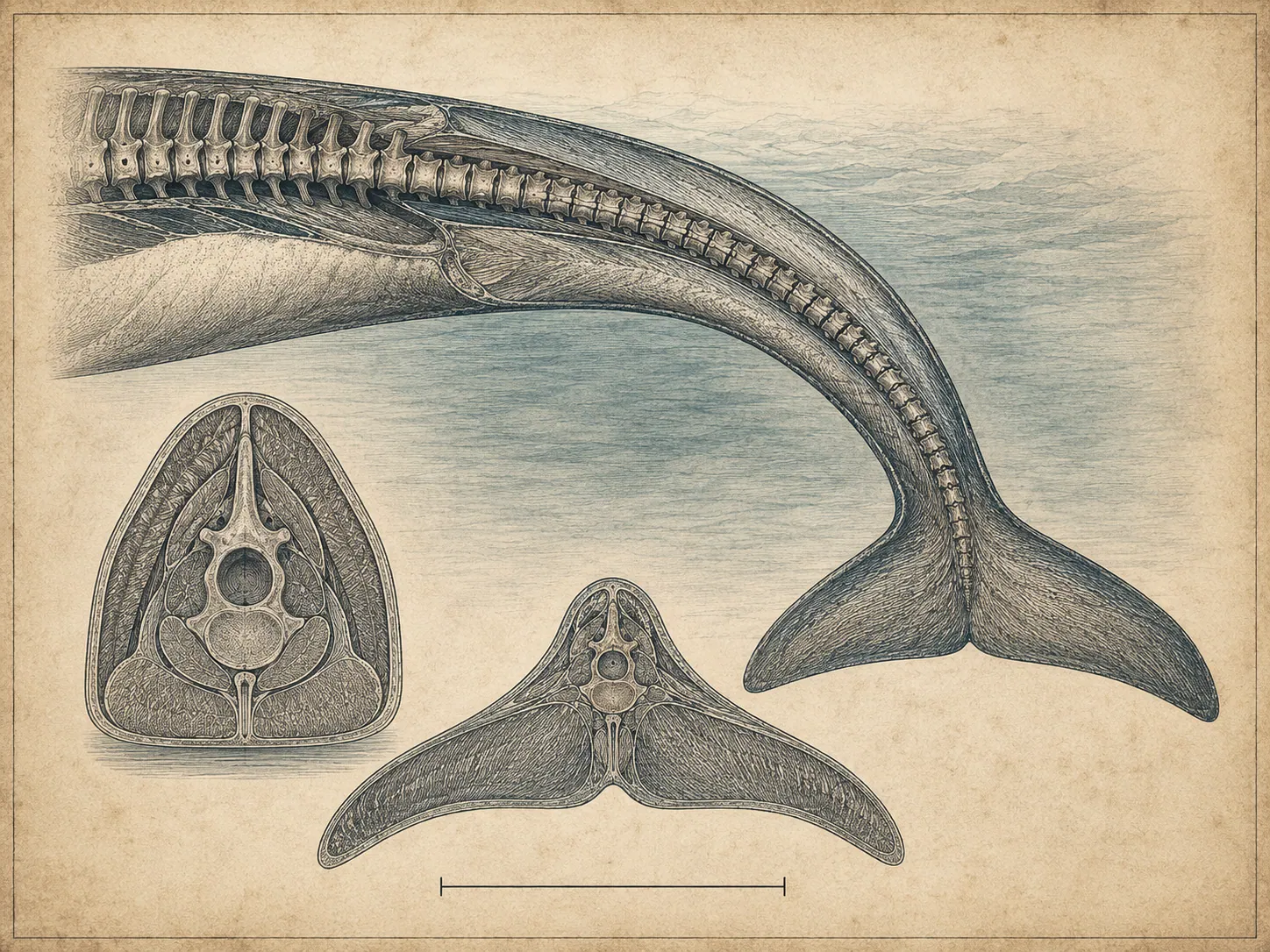
Not an eel, a shark
The biggest surprise was at the back. The fossil shows the tail vertebrae bending sharply downward near the end, with a tall fleshy fin carried above the bend.2 That is the build of a carangiform swimmer, an animal that drives itself with a deep, crescent-edged tail the way a shark or a mackerel does, not the long, eel-like undulator that mosasaurs had often been drawn as. The find pushed researchers to redraw the whole group with stiffer bodies and finned, downturned tails.
It preserves the body outline, scaly skin, and darker stains where the soft anatomy had been.
What it ate
Even the last meal is on record. A well-preserved Platecarpus gut shows moderate-sized fish, and the animal probably took squid and ammonites as well, a fast pursuit predator of the open mid-water rather than a crusher or a giant.1 It is a reminder that in palaeontology the rarest thing of all is not a big animal but a complete one.