The mosasaurs began as shoreline lizards and spent forty million years becoming better swimmers. Plotosaurus, from the latest Cretaceous of California, is where that journey reaches its end point. Cladistic studies place it on the most derived branch of the whole group, and you can see why in the shape of it.1
A body tuned for speed
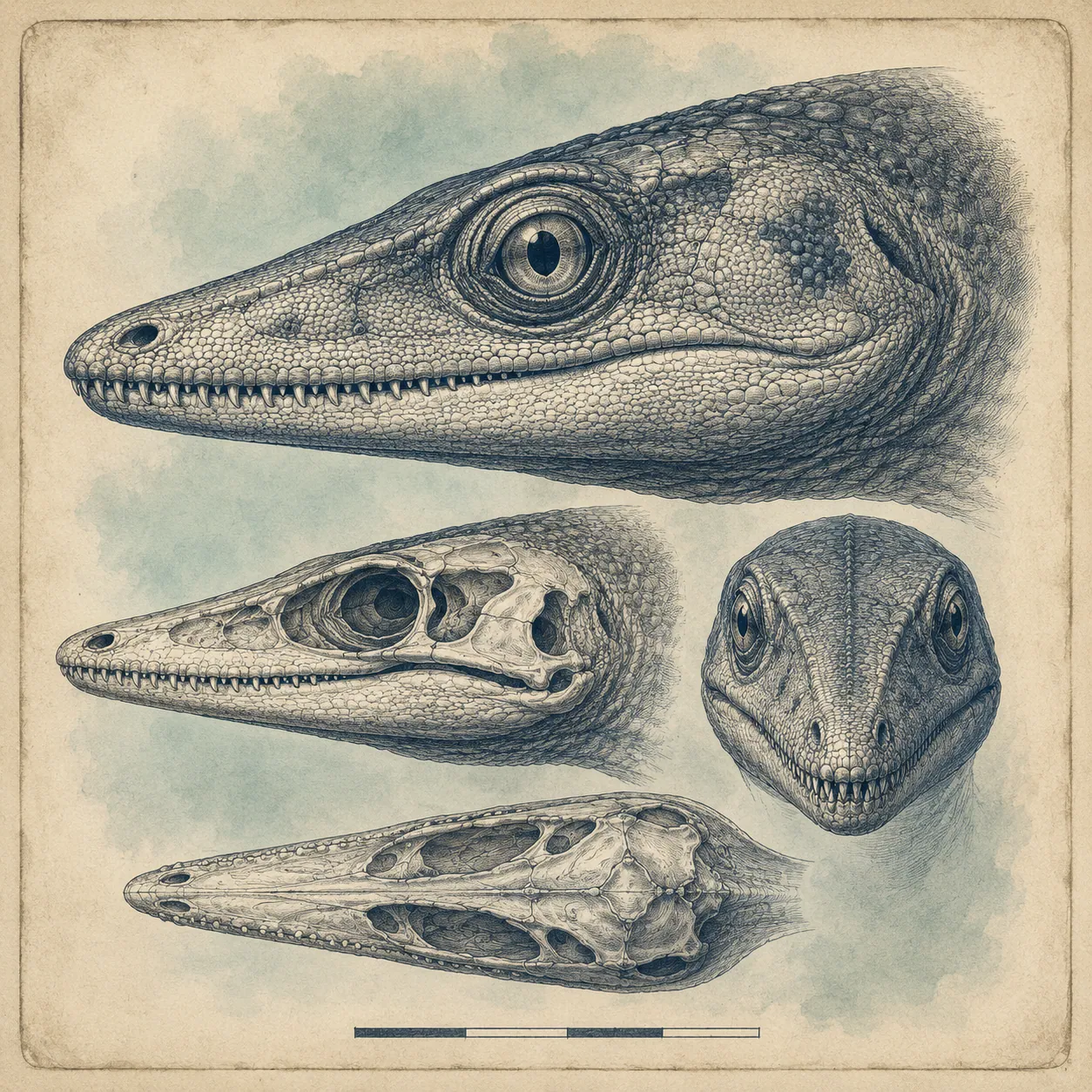
Almost everything about Plotosaurus is streamlined. The body is deep and fusiform, smooth as a fish; the flippers are narrowed; the tail carries a large fin and its vertebrae are partly fused for a stiffer, more powerful stroke.1 Its eyes are large. Put together, these are the marks of a fast, open-water pursuit predator, and they are strikingly similar to features in the ichthyosaurs, an entirely separate group of marine reptiles that had hit on the same fish-like solution tens of millions of years earlier. It is convergence in action, and it likely made Plotosaurus one of the quickest mosasaurs that ever lived.1
A name it had to swap
Its naming has a small twist. Charles Camp described it in 1942 as Kolposaurus, "bay lizard," only to find the name was already taken by another reptile. In 1951 he renamed it Plotosaurus, "swimmer lizard," which suits it far better.1
It is convergence in action: a lizard that had arrived, independently, at the shape of a fish.
And then time ran out. Plotosaurus lived in the final million years of the Cretaceous, the most refined swimmer its lineage ever produced, perfected just as the asteroid brought the whole experiment to a close.