Most fossil pterosaurs are known from a single crushed slab, if that. Pteranodon is the exception. More than a thousand specimens have come out of the chalk of Kansas and its neighbours, which makes it the best-understood flying reptile of the entire Mesozoic.1 They were the gulls and gannets of the Western Interior Seaway, a warm shallow ocean that once split North America in two, and a large male spread its wings more than seven metres, wider than a light aircraft.
Marsh's toothless wonder
Othniel Charles Marsh pulled the first fragments from the Kansas chalk around 1870, and in 1876 gave the animal a name that means, roughly, "toothless wing." That was the point: a complete lack of teeth was unique among pterosaurs at the time it was found. In place of a toothed jaw, Pteranodon carried a long, lightweight beak and a short tail no more than a few per cent of its wingspan.1 It was not a dinosaur, but a member of a separate flying lineage that branched off near the dinosaurs' own roots.
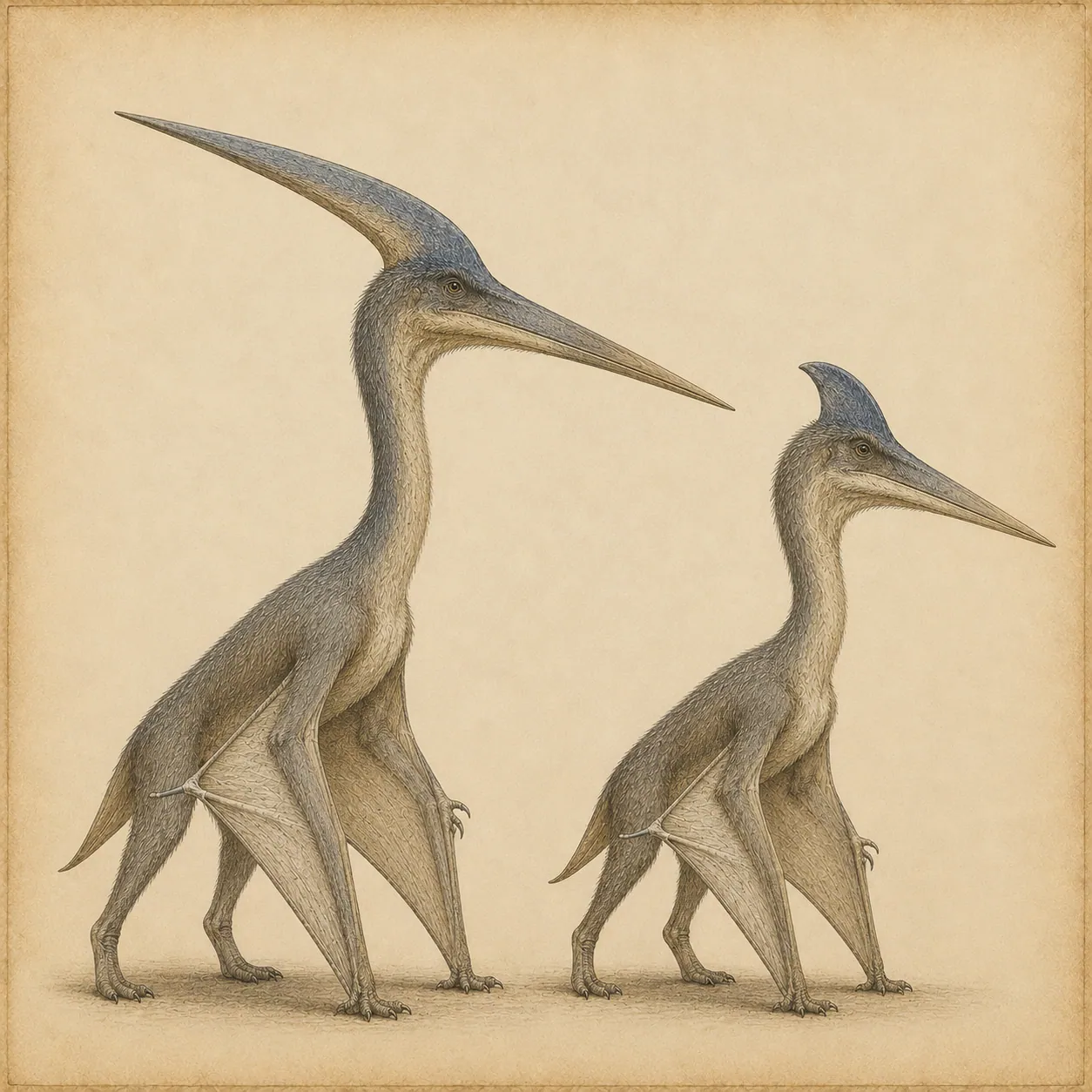
Telling the males from the females
With so many skeletons, a pattern emerges that almost no other pterosaur can show us. The specimens fall into two groups. One is large, with a long crest sweeping back off the skull; the other is about half the size, with a small rounded crest and a noticeably wider pelvis. The reading, argued in detail by Chris Bennett, is sexual dimorphism: big crested males, smaller broad-hipped females built to pass an egg.1 The crest itself was almost certainly a display structure rather than a rudder or a brake.
How it made a living
What it ate is not a guess. Fossil fish bones sit where the stomach would have been. Pteranodon was a fish-eater, and the favoured picture now is not the old one of a bird skimming its beak through the surface at speed, but something closer to a gannet or a pelican: dipping for fish at the surface, or making shallow plunges, perhaps while sitting on the water.1 For all its span it was light, with recent estimates putting a large individual at only twenty to thirty-five kilograms, an albatross-like glider built to ride the sea winds for hours.2
A complete lack of teeth was unique among pterosaurs at the time it was found.
That abundance is its real gift. Where most pterosaurs leave us one bone and a hundred questions, Pteranodon left a crowd, enough to watch a species grow, vary, and sort itself into two sexes across the chalk of a vanished sea.