Pull a Quetzalcoatlus skeleton out of the Texas badlands and the first problem is believing it flew at all. Folded on the ground it carried its head four to five metres up, level with a giraffe, balanced on four limbs with its wings packed away like a closed umbrella. Stretched out, those wings ran to about ten or eleven metres from tip to tip, wider than many small planes.1 It is one of the largest animals that has ever left the ground, and for a long time nobody could agree on how it managed.
A serpent named after a god
A geology student named Douglas Lawson found the first bones in 1971, weathering out of Big Bend in west Texas. When he and Wann Langston described the animal in 1975, they named it for Quetzalcoatl, the feathered serpent of Aztec belief, and gave the giant species the epithet northropi after Jack Northrop, the engineer behind the flying-wing aircraft. The holotype is fragmentary, mostly a single enormous wing.1 Much of what we now understand comes from a smaller relative, Quetzalcoatlus lawsoni, pulled from the same rocks and formally named only in 2021, in the first full redescription of the animal since Lawson's day.1
Big, and almost weightless
The trick to a creature this size is subtraction. Its bones were hollow, walled in places no thicker than an eggshell and braced inside with fine struts, the same logic an engineer uses to keep an airframe light. The neck was a short row of greatly elongated vertebrae; the skull carried a long toothless beak, finely pointed. Living weight has been argued over for decades. A figure of 200 to 250 kilograms became the working consensus, but the 2021 monograph put northropi closer to 150 kilograms: light, for an animal you could look in the eye while standing on a chair.1
Launching on all fours
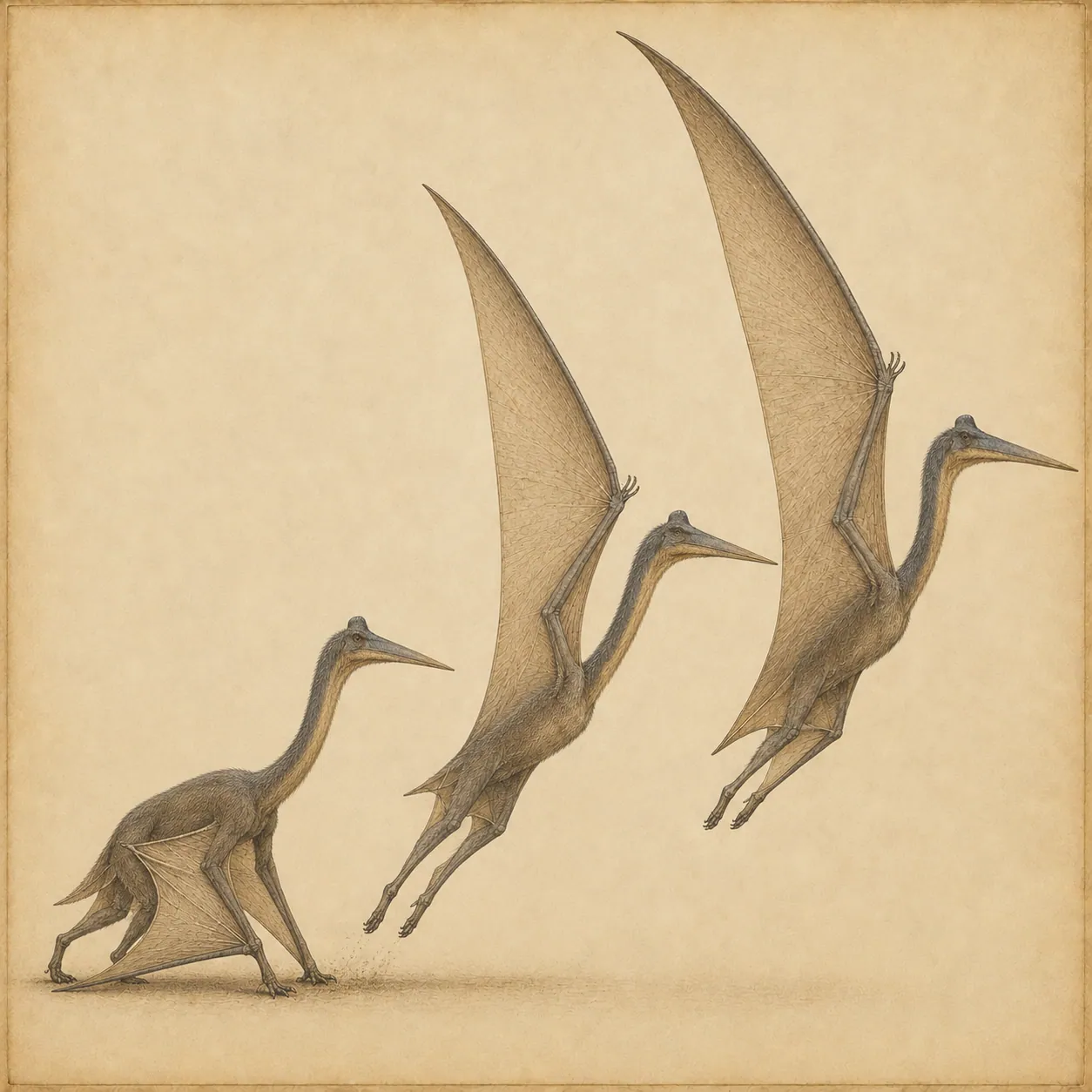
So how do you get that off the ground? Birds take a running start, or drop from a height, or beat their way up off the water. None of those work for an animal whose wingspan is wider than a country lane. The model most workers now favour, set out by Mark Witton and Michael Habib, is that Quetzalcoatlus used all four limbs at once: crouched, it loaded its powerful arms like a pole-vaulter, pushed off, and was already airborne before the first wingbeat. A pterosaur's forelimbs were far stronger than a bird's legs, which is what that launch demands.3 A 2021 paper revived the older idea of a two-legged, bird-style launch, but the four-limbed version remains the better fit for the bones.1
Its launch was a pole-vault: all four limbs at once, airborne before the first wingbeat.
A stork the size of a plane
People once pictured Quetzalcoatlus skimming the seas like an enormous gull, dragging its beak through the water for fish. The mechanics do not hold up, and neither does the setting: it lived inland, on floodplains far from any coast. The reconstruction that has held since 2008, from Witton and Darren Naish, is a terrestrial stalker, closer to a marabou stork or a ground hornbill scaled up to absurdity, pacing the Cretaceous plains on folded wings and stabbing down at whatever it could swallow whole.2 It hunted on foot and flew when it had somewhere to be.
Quetzalcoatlus was still working those floodplains at the very end of the Cretaceous, among the last pterosaurs of any kind. When the asteroid struck sixty-six million years ago, it went out with them, closing a hundred and sixty million years in which reptiles, not birds, carried the largest wings in the sky.