The limestone quarries of Solnhofen, in southern Germany, were laid down as the floor of a still, shallow lagoon about a hundred and fifty million years ago. The mud was so fine and the water so airless that animals which sank into it were preserved in astonishing detail.1 Rhamphorhynchus is one of its prizes: a small pterosaur, a metre and a half across the wings at most, that comes down to us not just as bone but as wing membrane and a fuzz of fine body fibres.
A mouth like a fish-trap
It belonged to the older, long-tailed grade of pterosaurs, the ones that came before the short-tailed pterodactyloids took over the skies. The jaws are unmistakable: around twenty teeth above and fourteen below, all of them needle-thin and angled sharply forward so that the upper and lower sets crossed and interlocked, with a fine toothless point at the very tip of the snout.1 It is a trap for slippery prey, and the gut contents agree: fish and the remains of cephalopods turn up again and again inside Rhamphorhynchus skeletons.
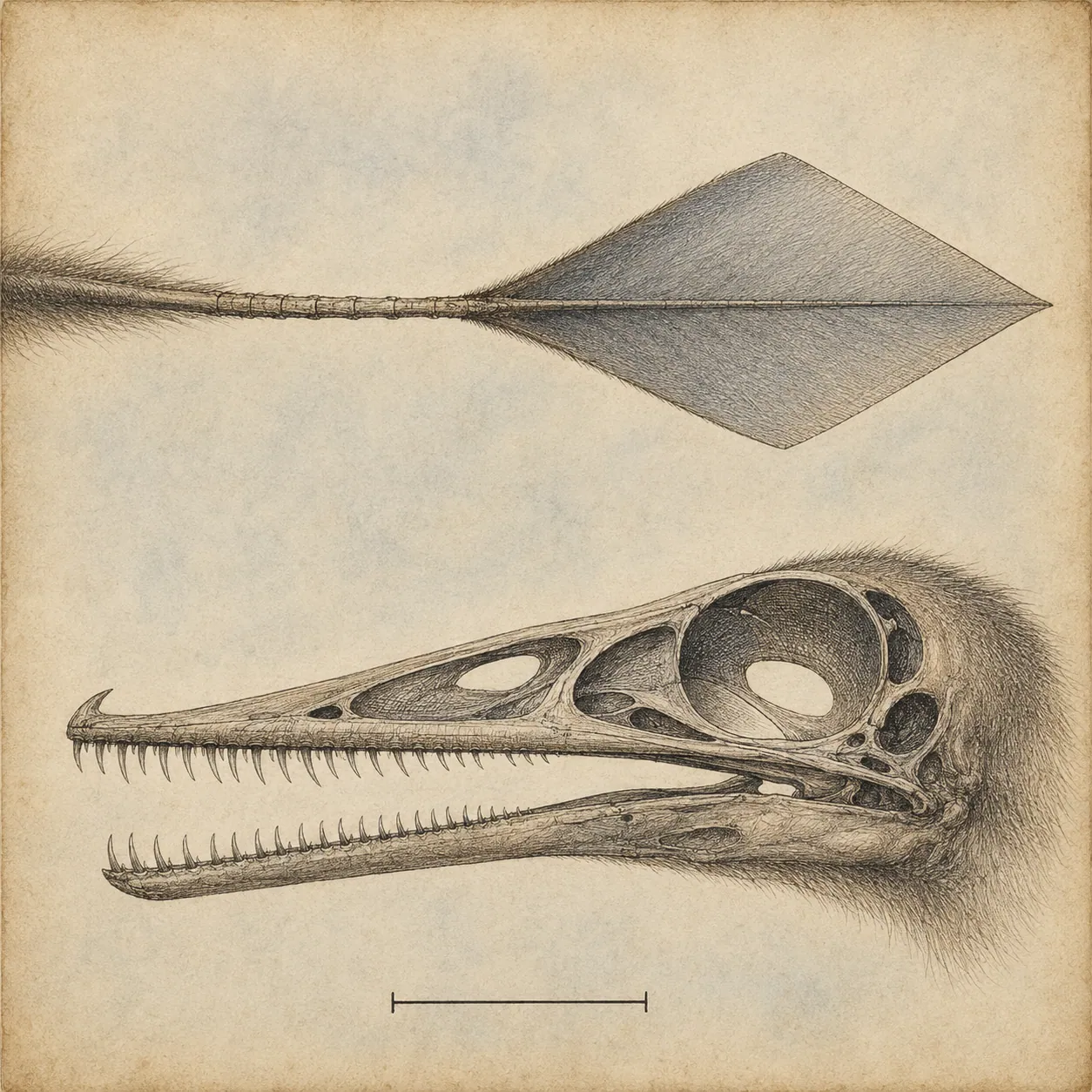
The kite at the end of the tail
The long tail was stiffened along most of its length by ligaments, holding it out straight behind the body like a pole. At the very end sat a vane of skin, and because Solnhofen preserves soft tissue we can watch that vane change as the animal grew. Chris Bennett traced it from a shallow oval in the youngest individuals, through a diamond, to a tall triangle in the largest.1 Held at the back of a flying animal, it would have worked as a rudder and stabiliser.
One species, many sizes
For a long time the Solnhofen pterosaurs were split into a confusing crowd of named species, sorted mostly by size. Bennett's 1995 review undid most of that: the supposed species were really year-classes of a single animal, Rhamphorhynchus muensteri, caught at different ages. A more recent study of the wing bones argues that the smallest hatchlings could already fly, which would mean these animals were on the wing almost from the moment they left the egg.1
It comes down to us not just as bone, but as wing membrane and a fuzz of fine body fibres.