For about thirty million years a warm sea split North America from the Gulf of Mexico to the Arctic. We call it the Western Interior Seaway, and its top predator was Tylosaurus. The largest known specimen, a Kansas giant nicknamed Bunker, measured a little over thirteen metres.1 Its skeletons come mostly out of the Smoky Hill Chalk, rock laid down on the floor of that vanished ocean.
A snout past the teeth
The feature that names the animal is at the front of the skull. In Tylosaurus the premaxilla, the bone at the tip of the upper jaw, projects forward as a stout, toothless rostrum that sticks out well beyond the first teeth.1 It is reinforced inside, built to take an impact, and the usual reading is that the animal used it like a battering ram, charging prey to stun it, and perhaps trading blows with its own kind.
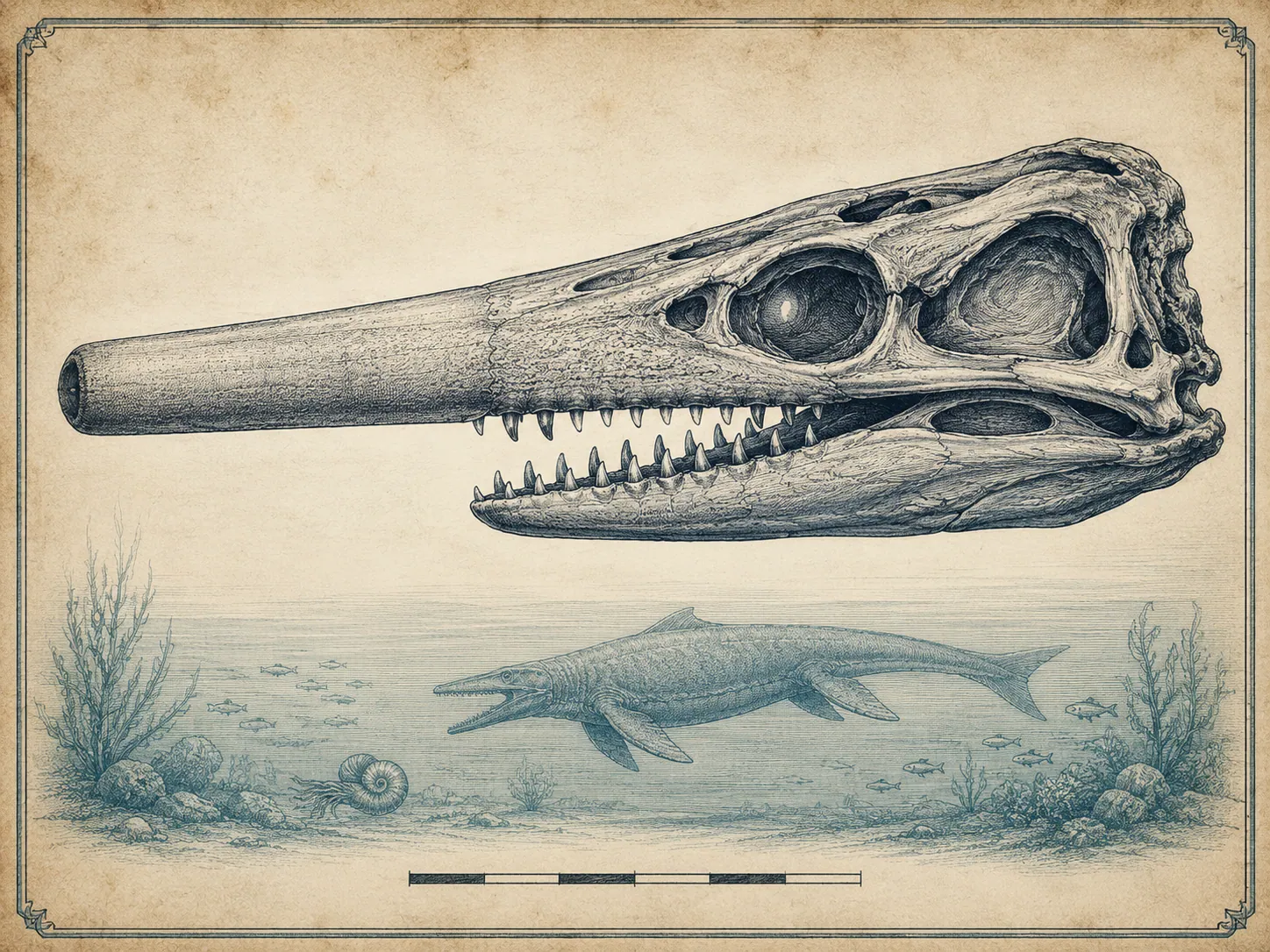
Behind that ram sat a serious set of jaws, with conical teeth above and below and the mosasaur's extra row on the palate. The diet matched the equipment. Stomach contents and bite-marked bones show Tylosaurus taking fish and sharks, plesiosaurs, smaller mosasaurs, and even, on the evidence, the occasional diving bird.1 It ate across the whole seaway, near the top and without much competition.
A child of the bone wars
Its naming is a piece of palaeontology's most famous feud. Edward Drinker Cope described the first remains in 1869; Othniel Charles Marsh, his bitter rival, soon erected a competing genus for the same kind of animal.1 The name Tylosaurus settled out of the wreckage in the early 1870s, and the genus has since swallowed others: the giant European tylosaurine Hainosaurus may be nothing more than a Tylosaurus under a different label.1
It carried its snout out past its own teeth, a stiff ram built to take an impact.
Whatever the labels, the animal itself is unambiguous: a fast, heavy, ramming predator that owned the inland sea right through the second half of the Cretaceous.